Inscribed on the pillar:

When
the Lord your God
brings you into the land
you are about to enter and occupy...
nations
mightier and more numerous
than you.
and when
the Lord your God
gives them over to you and...
you defeat them
then you must utterly destroy them.
Make no covenant with them
and show them no mercy.
Do not intermarry with them,
giving your daughters to their sons
or taking their daughters for your sons...
But this is how you must deal with them:
break down their altars,
smash their pillars,
hew down their sacred poles
and burn their idols with
fire.

Deuteronomy 7:1-5
The Whites of South Africa's
justification
for
Apartheid


Written along the edge of the circular plate:

Soweto (so-WEH-toe) is a nickname, too.  It is made up of
the first letters of SOuth WEstern TOwnships.
Townships are poor areas where black South Africans
live.  Blacks do not have the same freedoms that whites
have.  The system that created different rules for
blacks and whites is called "apartheid" (a-PART-hide).
The world means "separateness" in the Afrikaans
language.

Taken from the children's book
My Home Country:  South Africa is my Home by Jamie Daniel


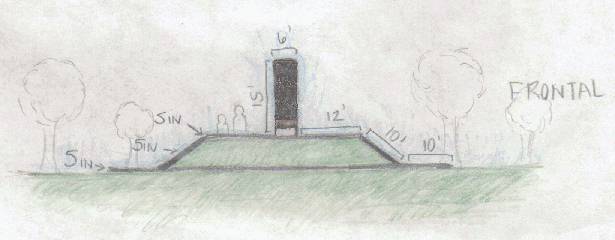
Technical:

Pillar:
6 feet in diameter
15 feet high
Starting from the top, pillar is constructed of:
133 inches of black marble
22 inches of brown marble
25 inches of white marble

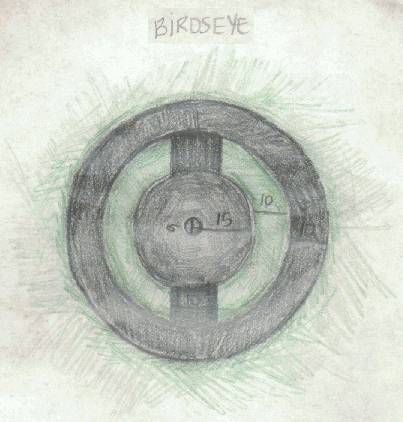
Circular plate:
The plate is 15 feet in diameter
and 5 inches thick
It is constructed of black marble

Second circular (donut) plate:
Creates a walkway (10 feet in width) around the monument
It is 5 inches thick
and is constructed of black marble

All marble is highly reflective


The Meaning of this Memorial:

The scripture from Deuteronomy was one used by the whites
in South Africa to justify the institution of apartheid.
When I first read this passage, I was disgusted and I included
 it in the memorial so that others might realize how loathsome
 and evil apartheid was (and is).

I included the excerpt from the children's book because it
 is such an innocent viewpoint of apartheid.  And I thought
it was really terrible that someone had to write such a book
 in the first place.  You're doing this whole series for
children about the different countries of the world and then
you come across South Africa.  What do you write about a place
 where such horrible things are going on?  I can just picture
 a nine year old picking up that book and deciding to do a
report on South Africa, and how oblivious that child would be
to what really went on.

The pillar itself is seventy-four percent black, fourteen
percent white, and twelve percent brown.  This represents
the percentage of each race in South Africa.  (The Indians
and "Coloreds" make up the brown section.)  I find it
ironic that the whites thought they had the right to
institute apartheid even though the land was not theirs and
 even though the blacks so thoroughly out numbered them.


Apartheid