What is Apartheid?
Let me just begin this by saying that I don't want to make it seem like I
know all there is to know about apartheid in South Africa because I certainly
don't. I am not an expert on the subject and I don't pretend to be. I'll try
my best to represent the facts (though you must know, if you know me, that I
will be threading in some of my own opinion where necessary). On multiple
occasions I've gone to library and picked me up some reading material, and that
is where my information comes from. I just feel that the subject is a very important
one. People think that what went on in the United States with slavery and civil
rights was extreme and terrible (and it most certainly was), but not many
know about the things that went on in South Africa, the great prejudices and
injustices that occured. I want to make sure as many people as possible know
the truth mainly because I don't want it to ever happen again.
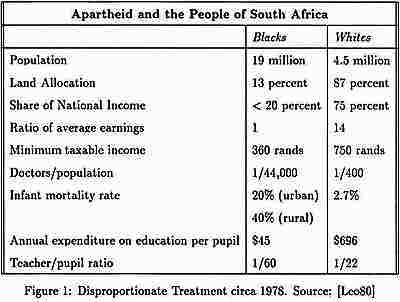
Many contributing factors went into the institution of apartheid laws in
South Africa (laws that enabled the white to grow rich while the blacks
remained poor and uneducated). Turbulence between the many diverse cultures
had always been abundant in the country. The Boers (or Dutch farmers who
were the first to settle the Cape in the 1600s, and their ancestors) felt nothing but spite
for the British colonists who arrived in the eighteenth century and proceeded
to take over the area. Two separate wars broke out between the Boers and the
British, resulting only in continued hatred, spite, and contempt.
Another contributor was the set of violent tribal wars
that was occuring between the different groups of "natives" in the area. These wars were
bloody and devastating to the black population of the Cape.
The discovery of diamonds and gold increased the need for cheap labor.
Black men would spend months away from their families earning low wages in
hazardous mines. And the white men were the ones who made a profit while
the blacks remained in poor housing with bad educations.
"Apartheid" is the Afrikaans (a language spoken by most whites in South
Africa, dervived from Dutch) word for "separateness." The first laws of
apartheid were instituted in 1948 (though before that, as early as 1760,
blacks were required to carry passes with them at all times to control the
movement of blacks to the cities). The apartheid laws were made into
legislation by Afrikaner (Dutch descended) Nationalists that had come into
power in the 1930s (if I'm not mistaken). The Afrikaner's were, in the first
place, revengeful because most of their land had been stolen from them by
the British in the eighteen hundreds. Also "for Afrikaner Nationalists apartheid meant
security. It meant that their language, their culture, their identity
would be preserved. They felt threatened by the large black population.
They disliked the white liberals and radicals whose policy was integration,
not apartheid."(1)
The Natives (Urban Areas) Act of 1923 had set up black townships outside of major
cities. Whites feared that they would have to compete with blacks for
housing, and they also wanted to control black migration. The land occupied
by the townships was owned by the government. Blacks could rent homes but not
buy them. "The point of the law was clear: Blacks were considered temporary
visitors, to be held at arm's length from the white cities...The black townships that
stood like shadows behind every major South African city were crowded; by one estimate,
in mid-1986, as
many as eight thousand people were on waiting lists for housing in Soweto. Such
housing ranged from a 'three-by-three'--a shack 3 yards square--to a typical
four-room 'match-box' house...Elsewhere in the township, families of ten or
more were living in four-foom homes that often had outdoor plumbing. Many
areas in the townships were still without electricity and paved roads. And
wages were so low that rent and utilities took up most of the average black
worker's pay. Conditions were even worse in the shantytowns, where blacks
who could not find room in the townships lived illegally and faced the threat
of eviction daily. Some homes were tin shacks; others were built from
cardboard and plastic bags so that they could be quickly dismantled should
the police appear."(2)
"Apartheid was enforced in all public
places. Notices reading EUROPEANS and NON-EUROPEANS (later changed to WHITES
and NON-WHITES) were placed at entrances to post offices, railway stations,
airports, and other public buildings. And there were separate movie houses,
theaters, and restaurants for the various race groups...In 1940 the
Prohibition of Mixed Marriages Act was passed, declaring marriages between
whites and other groups illegal. And the amendment to the Immorality Act
in 1950 prohibited sexual intercourse between whites and other racial groups.
The South African police kept close check on friendships across the color
line, prying into the private lives of individuals, hiding in bedrooms and
behind cars, and surprising individuals in the act of lovemaking. Arrests
were made, undignified medical tests were carried out, and charges were
pressed. Prison sentences of several months' duration were imposed on those
found guilty. In some cases black women were given stiffer sentences than
their white lovers for the same 'offense' "(3)
"In [1950] the government passed
a new law called the Suppression of Communism Act. Once this law was passed,
the Communist Party became an illegal organization and was automatically
banned. [The Minister of Justice] was now empowered to exclude an
individual from public life if, in his opinion, that individual was
'furthering the aims of Communism.' Many people were labeled 'Communists'
who were in fact not Communists at all. In the three decades following the
passing of this Act hundreds upon hundreds of South Africans of all races
and persuasions were banned. Most such 'banned' individuals were restricted
to certain areas, prevented from entering any educational institution, from
preparing any material for publication, and from attending any social
gatherings. No banned person was allowed to be quoted in the media or at
public gatherings, and the courts were powerless to intervene. Individuals
were banned for periods of five, ten, or even, in a few cases, fifteen
years."(4)
Opposers to the laws of apartheid were struck down, though some groups such
as the African National Congress (ANC) prevailed. Leaders and members of
such "subversive" organizations (like the ANC and the South African Indian
Congress and the multiracial Liberal Party were brought on trial for treason
but were acquitted five years after the trials began. On March 21, 1960,
the Pan-Africanist Congress (a branch-off from the ANC) and the ANC met in
Sharpeville, a black township, to protest the pass laws. Thousands of
unarmed blacks had gathered outside the Sharpeville police station. "There
they met up with a group of armed white South African policemen. The
protestors announced to the police that they had left their passbooks at
home and demanded to be arrested...As the crowd pressed against the high
fence surrounding the police station, some of the policemen opened fire on
the crowd. The protestors began fleeing in panic, but the police kept on
firing. Sixty-nine people were killed and 180 injured...The Sharpeville
massacre began a new era in South Africa. Many black leaders began to argue
that if people were killed for protesting peacefully, then perhaps it was
time for violent resistance to bring about change...The government declared
a State of Emergency and introduced what was practically martial law...
Strikes were ruthlessly suppressed, and a law was introduced making the
minimum penalty for sabotage five years' imprisonment and the maximum death.
The law also laid down severe penalties for strikers and slogan painters.
Hundreds of individuals were banned, and there were further infringements
of the freedom the press. Harsh detention laws wer introduced. Individuals
could be detained for 90 days without recourse to a court of law. This was
later extended to 180 days and today [1990] is virtually infinite."(5)
"It is very difficult to say how many people died in the conflicts between
June 1976 and the end of 1977. [These conflicts were sparked by a protest
by black schoolchildren in Soweto who were tired of the inferior education
they were being given. On June 16, 1976 police opened fire on the angry and
unarmed pupils. Many students were killed that day, and within a week 176
lives had been lost.] John Kane-Berman, in his book SOWETO: BLACK REVOLT,
WHITE REACTION, arrived at the figure of seven hundred deaths. Others have
claimed well over one thousand deaths. Nearly all of the dead were black
people. In addition thousands of people were arrested or detained without
trial...The terrifying violence in Soweto and elsewhere caused shockwaves
throughout South Africa and in many parts of the world. In South Africa
blacks were outraged, many embittered. Thousands of young black students
left South Africa to seek military training abroad, much of it organized by
the banned African National Congress."(6)
"Not all the violence taking place at this time was due to clashes between
police and protesters. Certain militant groups of black students and
adults took the law into their own hands. They set up special courts in
the townships and acted as judges and executioners. Individuals were
accused of providing information about revolutionary leaders to the police.
If found guilty the accused person was forced to lie on his or her back and
an automobile tire was placed around his or her neck. The tire was filled
with gasoline and then set alight. This flaming tire was known as a
'necklace' or 'necklace of fire.' While the victim was burning to death,
the accusers sang and danced around the flaming body...In the past few years
several hundred black people have died at the hands of rival black
organizations. Regrettably, black-on-black violence has been one of the
tragedies of the present-day South African situation."(7)
In February 1990 the beginning of the end of apartheid was finally in sight. The (white)
president of South Africa (F. W. de Klerk) lifted the ban on the ANC and other antiapartheid
organizations; he also announced the desegregation of public facilities. But
many people recognize the release of Nelson Mandela from prison on February
11, 1990 (after 28 years of incarceration) as the actual end to apartheid.
In June of 1991 the laws classifying people by race and restricting black
ownership of land were repealed. In 1993 a new constitution was adopted in
South Africa that granted equal rights to all citizens of all races. In
1994 the first election was held in which South Africans of all races were
allowed to vote. The previously-imprisoned and "symbol of black South
Africans' struggle for equality" Nelson Mandela was elected as president.
But the prejudice that was once so abundant in South Africa is not completely
wiped out. Hatred is still rank in the country. And this is only to be
expected because (as much as one might want to) you can't hope that an entire
population can change from hating
to loving overnight. I heard firsthand of an occurence that took place
recently concerning a white man from South Africa (and his blind and ignorant
bigotry) and the people who allowed him to be a bigot. But since the event was
so horrible and unflattering and unjust (and illegal?), I was asked not to
repeat the specifics of the story on this page.
FOOTNOTES:
(2) Pascoe, Elaine. SOUTH AFRICA: TROUBLED LAND. New York: Franklin Watts. 1992.
(1, 3, 4, 5, 6, 7,) Paton, Jonathan. THE LAND AND PEOPLE OF SOUTH AFRICA.
New York: J. B. Lippincott. 1990.
Apartheid
What is Apartheid?
Let me just begin this by saying that I don't want to make it seem like I
know all there is to know about apartheid in South Africa because I certainly
don't. I am not an expert on the subject and I don't pretend to be. I'll try
my best to represent the facts (though you must know, if you know me, that I
will be threading in some of my own opinion where necessary). On multiple
occasions I've gone to library and picked me up some reading material, and that
is where my information comes from. I just feel that the subject is a very important
one. People think that what went on in the United States with slavery and civil
rights was extreme and terrible (and it most certainly was), but not many
know about the things that went on in South Africa, the great prejudices and
injustices that occured. I want to make sure as many people as possible know
the truth mainly because I don't want it to ever happen again.
Many contributing factors went into the institution of apartheid laws in
South Africa (laws that enabled the white to grow rich while the blacks
remained poor and uneducated). Turbulence between the many diverse cultures
had always been abundant in the country. The Boers (or Dutch farmers who
were the first to settle the Cape in the 1600s, and their ancestors) felt nothing but spite
for the British colonists who arrived in the eighteenth century and proceeded
to take over the area. Two separate wars broke out between the Boers and the
British, resulting only in continued hatred, spite, and contempt.
Another contributor was the set of violent tribal wars
that was occuring between the different groups of "natives" in the area. These wars were
bloody and devastating to the black population of the Cape.
The discovery of diamonds and gold increased the need for cheap labor.
Black men would spend months away from their families earning low wages in
hazardous mines. And the white men were the ones who made a profit while
the blacks remained in poor housing with bad educations.
"Apartheid" is the Afrikaans (a language spoken by most whites in South
Africa, dervived from Dutch) word for "separateness." The first laws of
apartheid were instituted in 1948 (though before that, as early as 1760,
blacks were required to carry passes with them at all times to control the
movement of blacks to the cities). The apartheid laws were made into
legislation by Afrikaner (Dutch descended) Nationalists that had come into
power in the 1930s (if I'm not mistaken). The Afrikaner's were, in the first
place, revengeful because most of their land had been stolen from them by
the British in the eighteen hundreds. Also "for Afrikaner Nationalists apartheid meant
security. It meant that their language, their culture, their identity
would be preserved. They felt threatened by the large black population.
They disliked the white liberals and radicals whose policy was integration,
not apartheid."(1)
The Natives (Urban Areas) Act of 1923 had set up black townships outside of major
cities. Whites feared that they would have to compete with blacks for
housing, and they also wanted to control black migration. The land occupied
by the townships was owned by the government. Blacks could rent homes but not
buy them. "The point of the law was clear: Blacks were considered temporary
visitors, to be held at arm's length from the white cities...The black townships that
stood like shadows behind every major South African city were crowded; by one estimate,
in mid-1986, as
many as eight thousand people were on waiting lists for housing in Soweto. Such
housing ranged from a 'three-by-three'--a shack 3 yards square--to a typical
four-room 'match-box' house...Elsewhere in the township, families of ten or
more were living in four-foom homes that often had outdoor plumbing. Many
areas in the townships were still without electricity and paved roads. And
wages were so low that rent and utilities took up most of the average black
worker's pay. Conditions were even worse in the shantytowns, where blacks
who could not find room in the townships lived illegally and faced the threat
of eviction daily. Some homes were tin shacks; others were built from
cardboard and plastic bags so that they could be quickly dismantled should
the police appear."(2)
"Apartheid was enforced in all public
places. Notices reading EUROPEANS and NON-EUROPEANS (later changed to WHITES
and NON-WHITES) were placed at entrances to post offices, railway stations,
airports, and other public buildings. And there were separate movie houses,
theaters, and restaurants for the various race groups...In 1940 the
Prohibition of Mixed Marriages Act was passed, declaring marriages between
whites and other groups illegal. And the amendment to the Immorality Act
in 1950 prohibited sexual intercourse between whites and other racial groups.
The South African police kept close check on friendships across the color
line, prying into the private lives of individuals, hiding in bedrooms and
behind cars, and surprising individuals in the act of lovemaking. Arrests
were made, undignified medical tests were carried out, and charges were
pressed. Prison sentences of several months' duration were imposed on those
found guilty. In some cases black women were given stiffer sentences than
their white lovers for the same 'offense' "(3)
"In [1950] the government passed
a new law called the Suppression of Communism Act. Once this law was passed,
the Communist Party became an illegal organization and was automatically
banned. [The Minister of Justice] was now empowered to exclude an
individual from public life if, in his opinion, that individual was
'furthering the aims of Communism.' Many people were labeled 'Communists'
who were in fact not Communists at all. In the three decades following the
passing of this Act hundreds upon hundreds of South Africans of all races
and persuasions were banned. Most such 'banned' individuals were restricted
to certain areas, prevented from entering any educational institution, from
preparing any material for publication, and from attending any social
gatherings. No banned person was allowed to be quoted in the media or at
public gatherings, and the courts were powerless to intervene. Individuals
were banned for periods of five, ten, or even, in a few cases, fifteen
years."(4)
Opposers to the laws of apartheid were struck down, though some groups such
as the African National Congress (ANC) prevailed. Leaders and members of
such "subversive" organizations (like the ANC and the South African Indian
Congress and the multiracial Liberal Party were brought on trial for treason
but were acquitted five years after the trials began. On March 21, 1960,
the Pan-Africanist Congress (a branch-off from the ANC) and the ANC met in
Sharpeville, a black township, to protest the pass laws. Thousands of
unarmed blacks had gathered outside the Sharpeville police station. "There
they met up with a group of armed white South African policemen. The
protestors announced to the police that they had left their passbooks at
home and demanded to be arrested...As the crowd pressed against the high
fence surrounding the police station, some of the policemen opened fire on
the crowd. The protestors began fleeing in panic, but the police kept on
firing. Sixty-nine people were killed and 180 injured...The Sharpeville
massacre began a new era in South Africa. Many black leaders began to argue
that if people were killed for protesting peacefully, then perhaps it was
time for violent resistance to bring about change...The government declared
a State of Emergency and introduced what was practically martial law...
Strikes were ruthlessly suppressed, and a law was introduced making the
minimum penalty for sabotage five years' imprisonment and the maximum death.
The law also laid down severe penalties for strikers and slogan painters.
Hundreds of individuals were banned, and there were further infringements
of the freedom the press. Harsh detention laws wer introduced. Individuals
could be detained for 90 days without recourse to a court of law. This was
later extended to 180 days and today [1990] is virtually infinite."(5)
"It is very difficult to say how many people died in the conflicts between
June 1976 and the end of 1977. [These conflicts were sparked by a protest
by black schoolchildren in Soweto who were tired of the inferior education
they were being given. On June 16, 1976 police opened fire on the angry and
unarmed pupils. Many students were killed that day, and within a week 176
lives had been lost.] John Kane-Berman, in his book SOWETO: BLACK REVOLT,
WHITE REACTION, arrived at the figure of seven hundred deaths. Others have
claimed well over one thousand deaths. Nearly all of the dead were black
people. In addition thousands of people were arrested or detained without
trial...The terrifying violence in Soweto and elsewhere caused shockwaves
throughout South Africa and in many parts of the world. In South Africa
blacks were outraged, many embittered. Thousands of young black students
left South Africa to seek military training abroad, much of it organized by
the banned African National Congress."(6)
"Not all the violence taking place at this time was due to clashes between
police and protesters. Certain militant groups of black students and
adults took the law into their own hands. They set up special courts in
the townships and acted as judges and executioners. Individuals were
accused of providing information about revolutionary leaders to the police.
If found guilty the accused person was forced to lie on his or her back and
an automobile tire was placed around his or her neck. The tire was filled
with gasoline and then set alight. This flaming tire was known as a
'necklace' or 'necklace of fire.' While the victim was burning to death,
the accusers sang and danced around the flaming body...In the past few years
several hundred black people have died at the hands of rival black
organizations. Regrettably, black-on-black violence has been one of the
tragedies of the present-day South African situation."(7)
In February 1990 the beginning of the end of apartheid was finally in sight. The (white)
president of South Africa (F. W. de Klerk) lifted the ban on the ANC and other antiapartheid
organizations; he also announced the desegregation of public facilities. But
many people recognize the release of Nelson Mandela from prison on February
11, 1990 (after 28 years of incarceration) as the actual end to apartheid.
In June of 1991 the laws classifying people by race and restricting black
ownership of land were repealed. In 1993 a new constitution was adopted in
South Africa that granted equal rights to all citizens of all races. In
1994 the first election was held in which South Africans of all races were
allowed to vote. The previously-imprisoned and "symbol of black South
Africans' struggle for equality" Nelson Mandela was elected as president.
But the prejudice that was once so abundant in South Africa is not completely
wiped out. Hatred is still rank in the country. And this is only to be
expected because (as much as one might want to) you can't hope that an entire
population can change from hating
to loving overnight. I heard firsthand of an occurence that took place
recently concerning a white man from South Africa (and his blind and ignorant
bigotry) and the people who allowed him to be a bigot. But since the event was
so horrible and unflattering and unjust (and illegal?), I was asked not to
repeat the specifics of the story on this page.
FOOTNOTES:
(2) Pascoe, Elaine. SOUTH AFRICA: TROUBLED LAND. New York: Franklin Watts. 1992.
(1, 3, 4, 5, 6, 7,) Paton, Jonathan. THE LAND AND PEOPLE OF SOUTH AFRICA.
New York: J. B. Lippincott. 1990.
Apartheid