Apartheid Reading Material
Fiction:
CRY, THE BELOVED COUNTRY by Alan Paton
An excellent portrayal of pre-apartheid South Africa. A story about prejudice and hatred,
blindness to the fact that we are all human beings and deserve to be treated equally.
This is the fictional tale of Stephen Kumalo and his search for his brother, sister, and
son in the corrupt town of Johannesburg. Everything Kumalo once knew is torn to pieces
when he travels to the city. His son is charged with murder, and must face a court that
sees him as a native, a being of less intelligence and importance. CRY, THE BELOVED
COUNTRY is also about a white man's revelation, his transformation from a white man to a
Christian, a man who accepts his fellow (black) man and who is not afraid to live beside him.
CRY, THE BELOVED COUNTRY provides the reader with a view of what it was like in South
Africa just before the laws of apartheid were instituted. Not many people these days
(especially young adults in school who should be learning about the history of apartheid)
have a clue what did go on and what is still occurring today in South Africa. They
have not heard of the injustices that went on, the killings, the destruction, the poverty, and
the prejudice. This novel provides a small look into the lives of the blacks. A look that
every one needs to experience if we are to learn from our mistakes.
The novel itself, technically, is written in a lyrical manner, one that is incredibly pleasing
and easy to read. The book goes by quickly and the reader finds himself or herself not
wanting it to end. Some of the story is written in a poetic style. The author deviates from
the story to let us see what the typical people of the city are going through, their trials and
tribulations. He creates strong images and feelings. He touches the reader's soul. These
chapters, in my opinion, are the best parts of the book.
Cry, the Beloved Country should be read, if for no other reason, so that history will not
repeat itself, so that we will learn, so that one day prejudice will no longer exist.
Autobiography: KAFFIR BOY: The True Story of a Black Youth's Coming of Age in Apartheid South Africa


Definitely the best thing I have read so far concerning apartheid South Africa.
It is an excellent book. I am not brought to tears by many books, I guess that
means that I haven't been reading any truly well-written books lately, but
KAFFIR BOY made me cry. The excerpt above was my favorite part of the book.
The autobiography chronicles a boy's life from the time he is five until he's eighteen. Very
well written. The first part of the book was the most enjoyable; near the end
it gets really wrapped up in Johannes/Mark's tennis goals, and ceases really
discussing what's going on in South Africa. We still get a little insight but
the last part of the book just dragged for me. And yet, the last chapter is
very good. Usually books just die off at the end, but KAFFIR BOY ended well.
Lots of insight, lots of tears. I learned things I hadn't known in the past,
which was an added bonus.
Non-Fiction past and present: SOUTH AFRICA: TROUBLED LAND by Elaine Pascoe Now I haven't yet
read it; I only used it as a reference for this page. It is a chronicle of apartheid from the
very beginning, the first people of South Africa and the arrival of the Europeans. Included is
a helpful time-line.
THE LAND AND THE PEOPLE OF SOUTH AFRICA by Jonathan Paton (and I'm just now wondering if he is
any relation to Alan Paton) The last half of the book is about apartheid (while the first is
about the "the land and people" and older history of the country). Helpful pictures, apartheid
poety, much information about the critical people and moments in apartheid history. Definitely
the best reference book that you could pick up concerning apartheid that I have of yet run across.
ILLUSTRATED HISTORY OF SOUTH AFRICA: THE REAL STORY Very complete. Everything you ever wanted to
know about South Africa in a textbook format.
Non-Fiction concerning 'current' conditions in South Africa: NATIONAL GEOGRAPHIC. "The Twilight of Apartheid."
February 1993.
Apartheid
Apartheid Reading Material
Fiction:
CRY, THE BELOVED COUNTRY by Alan Paton
An excellent portrayal of pre-apartheid South Africa. A story about prejudice and hatred,
blindness to the fact that we are all human beings and deserve to be treated equally.
This is the fictional tale of Stephen Kumalo and his search for his brother, sister, and
son in the corrupt town of Johannesburg. Everything Kumalo once knew is torn to pieces
when he travels to the city. His son is charged with murder, and must face a court that
sees him as a native, a being of less intelligence and importance. CRY, THE BELOVED
COUNTRY is also about a white man's revelation, his transformation from a white man to a
Christian, a man who accepts his fellow (black) man and who is not afraid to live beside him.
CRY, THE BELOVED COUNTRY provides the reader with a view of what it was like in South
Africa just before the laws of apartheid were instituted. Not many people these days
(especially young adults in school who should be learning about the history of apartheid)
have a clue what did go on and what is still occurring today in South Africa. They
have not heard of the injustices that went on, the killings, the destruction, the poverty, and
the prejudice. This novel provides a small look into the lives of the blacks. A look that
every one needs to experience if we are to learn from our mistakes.
The novel itself, technically, is written in a lyrical manner, one that is incredibly pleasing
and easy to read. The book goes by quickly and the reader finds himself or herself not
wanting it to end. Some of the story is written in a poetic style. The author deviates from
the story to let us see what the typical people of the city are going through, their trials and
tribulations. He creates strong images and feelings. He touches the reader's soul. These
chapters, in my opinion, are the best parts of the book.
Cry, the Beloved Country should be read, if for no other reason, so that history will not
repeat itself, so that we will learn, so that one day prejudice will no longer exist.
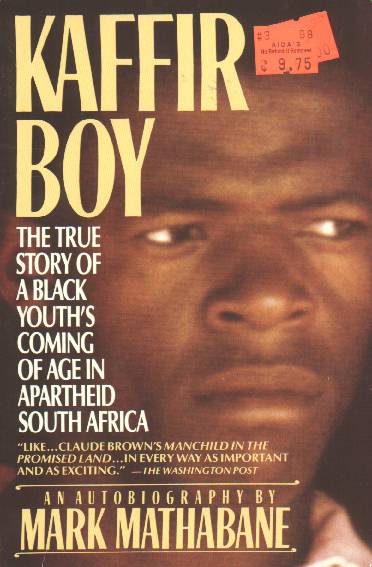
Autobiography: KAFFIR BOY: The True Story of a Black Youth's Coming of Age in Apartheid South Africa
Definitely the best thing I have read so far concerning apartheid South Africa.
It is an excellent book. I am not brought to tears by many books, I guess that
means that I haven't been reading any truly well-written books lately, but
KAFFIR BOY made me cry. The excerpt above was my favorite part of the book.
The autobiography chronicles a boy's life from the time he is five until he's eighteen. Very
well written. The first part of the book was the most enjoyable; near the end
it gets really wrapped up in Johannes/Mark's tennis goals, and ceases really
discussing what's going on in South Africa. We still get a little insight but
the last part of the book just dragged for me. And yet, the last chapter is
very good. Usually books just die off at the end, but KAFFIR BOY ended well.
Lots of insight, lots of tears. I learned things I hadn't known in the past,
which was an added bonus.
Non-Fiction past and present: SOUTH AFRICA: TROUBLED LAND by Elaine Pascoe Now I haven't yet
read it; I only used it as a reference for this page. It is a chronicle of apartheid from the
very beginning, the first people of South Africa and the arrival of the Europeans. Included is
a helpful time-line.
THE LAND AND THE PEOPLE OF SOUTH AFRICA by Jonathan Paton (and I'm just now wondering if he is
any relation to Alan Paton) The last half of the book is about apartheid (while the first is
about the "the land and people" and older history of the country). Helpful pictures, apartheid
poety, much information about the critical people and moments in apartheid history. Definitely
the best reference book that you could pick up concerning apartheid that I have of yet run across.
ILLUSTRATED HISTORY OF SOUTH AFRICA: THE REAL STORY Very complete. Everything you ever wanted to
know about South Africa in a textbook format.
Non-Fiction concerning 'current' conditions in South Africa: NATIONAL GEOGRAPHIC. "The Twilight of Apartheid."
February 1993.
Apartheid
Definitely the best thing I have read so far concerning apartheid South Africa.
It is an excellent book. I am not brought to tears by many books, I guess that
means that I haven't been reading any truly well-written books lately, but
KAFFIR BOY made me cry. The excerpt above was my favorite part of the book.
The autobiography chronicles a boy's life from the time he is five until he's eighteen. Very
well written. The first part of the book was the most enjoyable; near the end
it gets really wrapped up in Johannes/Mark's tennis goals, and ceases really
discussing what's going on in South Africa. We still get a little insight but
the last part of the book just dragged for me. And yet, the last chapter is
very good. Usually books just die off at the end, but KAFFIR BOY ended well.
Lots of insight, lots of tears. I learned things I hadn't known in the past,
which was an added bonus.
Non-Fiction past and present: SOUTH AFRICA: TROUBLED LAND by Elaine Pascoe Now I haven't yet
read it; I only used it as a reference for this page. It is a chronicle of apartheid from the
very beginning, the first people of South Africa and the arrival of the Europeans. Included is
a helpful time-line.
THE LAND AND THE PEOPLE OF SOUTH AFRICA by Jonathan Paton (and I'm just now wondering if he is
any relation to Alan Paton) The last half of the book is about apartheid (while the first is
about the "the land and people" and older history of the country). Helpful pictures, apartheid
poety, much information about the critical people and moments in apartheid history. Definitely
the best reference book that you could pick up concerning apartheid that I have of yet run across.
ILLUSTRATED HISTORY OF SOUTH AFRICA: THE REAL STORY Very complete. Everything you ever wanted to
know about South Africa in a textbook format.
Non-Fiction concerning 'current' conditions in South Africa: NATIONAL GEOGRAPHIC. "The Twilight of Apartheid."
February 1993.
Apartheid